


Design x Virgil Abloh – design in quotation marks
Raf Simons stated that his designs are derivative and do not bring in anything new to the fashion industry.


See also:
Raf Simons stated that his designs are derivative and do not bring in anything new to the fashion industry. One may agree with the notion or not. Former Kanye West protégé, a trained architect nonetheless, is a perfect embodiment of his own era. The times when juggling with motifs, mixing references, requoting quotes became an art in itself. If we live in the period of “late postmodernity”, Abloh is the visualization of its design. Dadaist ready-mades are a favorite patent feature in his repertoire. Ironic or pastiche conceptualism? There you have it. “A style of its own,” admirers would say while the critics will snarl that it is just “a lack of ideas”. Like Matthew Williams, who recently took over the art direction of Givenchy, and Kim Jones, who designed for Dior and Fendi, the American comes from the world of streetwear. For several years, he has been the artistic director of the men’s line of the Louis Vuitton fashion house, at the same time cooperating with a whole galaxy of brands, artists, galleries and institutions. Additionally, he runs his own project. Luxury brands and large corporations have long ceased to refrain from and regularly use aesthetic codes and ideas developed by popular culture and street art.
Is the founder of Off-White a modern day Warhol? Time will tell. He certainly borrows a lot from him, and his work is like well-tuned financial instruments, paraphrasing Polish rap veteran Włodi. What he creates sells smoothly and gracefully. It won’t take long for the product typologies that he literally put in quotation marks to end. From the Evian water bottle to the (originally) off-road Mercedes-Benz, from Nike shoes to Rimowa suitcases.
In this uninterrupted sequence, it is worth looking at a few selected projects realized in the furniture form. There is both a controlled pastiche, a colorful negation of modernism, an artistic approach and carefully planned nonchalance.
Vitra.
Vitra, like Knoll, Cassina or Fritz Hansen, is an example of a brand that bases its success on a portfolio filled with classic modernist furniture designs. Although they update with new furniture created with contemporary renowned designers, it’s a rather conservative line. Working with Abloh seems to be an attempt to soften this image. In this the German producer, evidently, having a go at younger consumers’ attention. Twentythirtyfive, because that is the title of the project, is a verbal transcription of the year 2035, because both sides have decided to deal with furniture futurology.
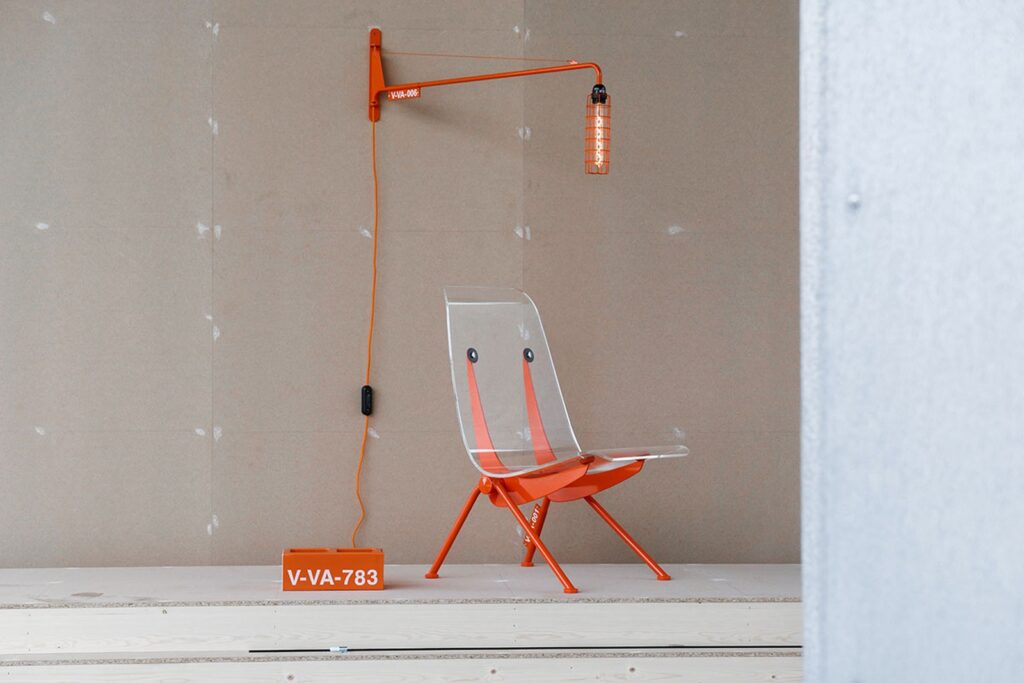
The collection is small, with only three objects – Antony armchair, Petite Potence lamp and a brick block. The furniture is a variation on the patterns by Jean Prouvé, and the last element is most likely an intentional irony marker that summons an instant association with the Supreme collection brick. In the chair, the interference involved introducing a furiously orange color into the finish of the structure and the elimination of plywood from the seat in favor of plexiglass. The lamp, on the other hand, has an openwork bulb holder made of a thin metal sieve typical for technical lighting.
In addition, both products have a small, welded-on plate with a signature – the tendency to mark and label is, as you can see in the case of an American, overwhelming.
Shown, among others, at the Art Basel in 2019, the installation presented the collection in two sets. Entitled “Past / Present”, the first showed a teenager’s room today and “Tomorrow”, in the aforementioned 2035, when the young man grows up. Anticipation happens here mainly on an aesthetic level. It is difficult to say whether the fluorescent colors used in recent seasons will return in the middle of the fourth decade of the 21st century. Two things, however, seem to be certain. First, as Mark Twain once said, “Prediction is difficult, especially when it comes to the future.” Secondly, styling a masterpiece is a risky game that is usually lost, because the Pastiche casino wants what’s theirs and that’s that. In this case, the applied motif of modernizing the bygone avant-garde worked only partially. It delivered publicity and circulation, and a barely touched topic should be treated mainly as a show of openness to contemporary trends and mixing product or aesthetic categories.
The world is passionately working on twentieth-century achievements at the moment. And as it is lately often the case, it does so in a bipolar fashion. It constantly pushes for the new yet often conserves the past achievements, checking how they will fare after slight modifications or a change of context. In this particular context the author of the prototypes, that is Jean Prouvé, is certainly interesting. A timelessly modern creator who’s designs remained sophisticated in their simplicity, equally beautiful as they are well thought-out and useful, full of pioneering engineering solutions. Unique in form, although intended for mass production. Utilitarian, painfully modernist, today they are the object of sighs of design and art collectors all over the world, but his projects are also an objects of admiration for the luxury brands, that syphon elements of their own artistic communication out of them (Bally, G-star or Kvadrat / Raf Simons ).
Abloh recently took another classic example of twentieth century design to his workshop – the G-Class Mercedes-Benz. The project “Geländewagen” carried out with the head of the design department of the German automotive giant, Gorden Wagener. The cooperation is the resultant of a crazy tuner and a genius stylist actions. The car, which over the years has become an exemplification of an off-road vehicle per se, after lowering and widening, has been turned into a racing car. The nuances give it a unique form, such as blue color accents, a vision of rustic luxury and praise of imperfection. The American artist likes to repeat that in order for a given product to receive a new form, it is enough to change only three percent of its structure. It is difficult to say whether a formula can be derived from that statement.

Ikea.
Design is democratic, one of the flagship slogans of the Swedish concern. The intention is quite right in itself. In their release, it manifests itself in a modernist style in terms of accessibility and postmodern performance, looking at the eclecticism of forms and treatments. Charlotte Perriand’s ideals (despite the commercialized form) resound here under the banner of l’art de vivre. The French woman also treated design as a social tool, an emblem of the quality of life and its affirmation at the same time. The art of living is not a pose – the real lifestyle is not superficial, and the aesthetic issues can be as important as the utilitarian. So much for the soft modernist ideals. Design has not ceased to be a social tool, but has also become a business and image tool. Ebenistic traditions, artistic dimensions, combine today with a mass scale into one great circulation.
In recent years, Ikea has been intensively working on a new dimension of its brand, several at a time to be fair. Known for the available furniture, nowadays it focuses more and more on recognized designers with loud or very loud names, designing experiences in the form of installations at fairs or city spaces. The presence at Salone del Mobile is symptomatic and shows the ambition to be a brand chosen not only rationally but also emotionally. The Space10 research center is responsible for developing and designing future solutions related to housing issues in the social, urban and ecological context. This list includes capsule collections that are to make it, at least to some extent, a company with lifestyle potential. We have other brands here that complement or expand the offer of the furniture concern, but also give a new context to the brand itself. The portfolio here is wide and includes Lego or the now defunct Parisian concept store Colette, as well as Byredo and Sonos. Similarly, the list of artists or designers with whom the Swedish company cooperates contains many names like Craig Redman, Olafur Eliasson, Chris Stampd, Per B. Sundberg, Craig Green and Filip Pągowski just to mention a few.
Working with Abloh is therefore part of a broader strategy. In terms of communication, Ikea is known for its excellent reflexes and sense of humor. They proved it many times, for example when Balenciaga presented a blue bag that was confusingly similar to their all-known model Frakta. The Ikea x Virgil Abloh (Markerad) collection has good quality humor and Dadaist charm. There is no shortage of a signature treatment in the form of words in quotation marks applied to the products. The offer includes, for example, carpets with inscriptions “Wet Gras”, “Keep Off”, “Still Loading” (great) or a white (not very legible) clock with the slogan “Temporary”. There are also classic accessories and furniture, such as a table, chair or bedding set, and even a tool kit. The millennial generation to whom this line was directed could easily develop their first apartment with these things, as long as they managed to acquire these limited (mass exclusivity in laboratory form) objects.
High outlines
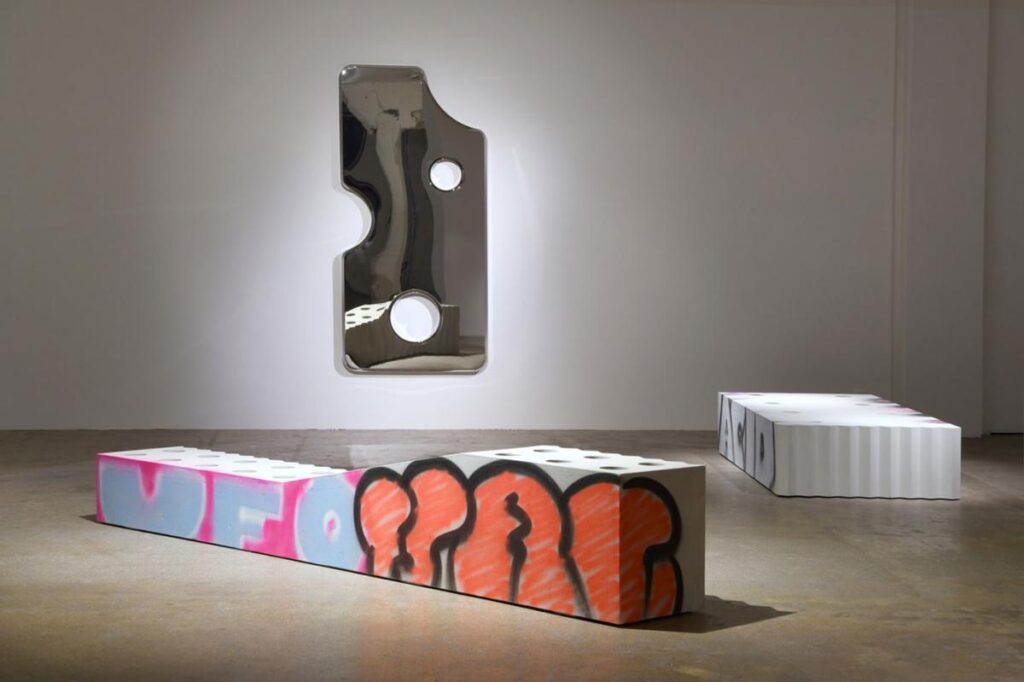
Abloh’s have already received a lot of recognition both in terms of art (although it was also criticized) and business. In 2019, the prestigious Museum of Contemporary Art in his hometown of Chicago hosted a monographic exhibition presenting his achievements to date in the field of fashion design, entertainment, experience creation, visual art and DJ career. The conclusions of this event are as follows: cultural institutions are opening up to new forms and topics of the exhibition, rejuvenating the audience, and that Abloh, after all, may have the makings of a 21st century Warhol. Art and business development is becoming increasingly similar. In the world of design, he can be seen as a dilettante. Although he has a specialized education in this field, his practice is scarce. However, long before him, artists and architects designed furniture, so it is not a precedent here, but rather a confirmation of a growing trend. A trend that seeks both an artistic dimension for design and sees it as a marketing tool. Abloh creates interior design products for its own Off-White brand, as well as for leading galleries. During the Venice Biennale Carpenters Workshop Gallery, he showed chairs and floor lamps from the “Acqua Alta” collection. In Paris and London, Galerie kreo exhibited Efflorescence: a collection of furniture composed of twenty objects. You can see them both known from his fashion designs, but also with references to street culture and brutalism. Concrete seats or tables covered with graffiti adjoin polished steel.
Polishing
Contemporary times begin to function in many closed systems when it comes to self-expression, created according to specific patterns. They are made up of a sequence of ideas that make up one common image, known as the lifestyle. Subsequent things and activities must be compatible with each other and work on the overall image. Therefore, brands see the potential in expanding the range of their own services and competences. Sport is smoothly turning into fashion. Fashion is combined with cuisine, design and travel. Culture and art nuance all of this, adding the necessary intellectual and emotional value. The process of aestheticization is like applying layers and then varnishing, smoothing and polishing them.

Share


